
Design Notes
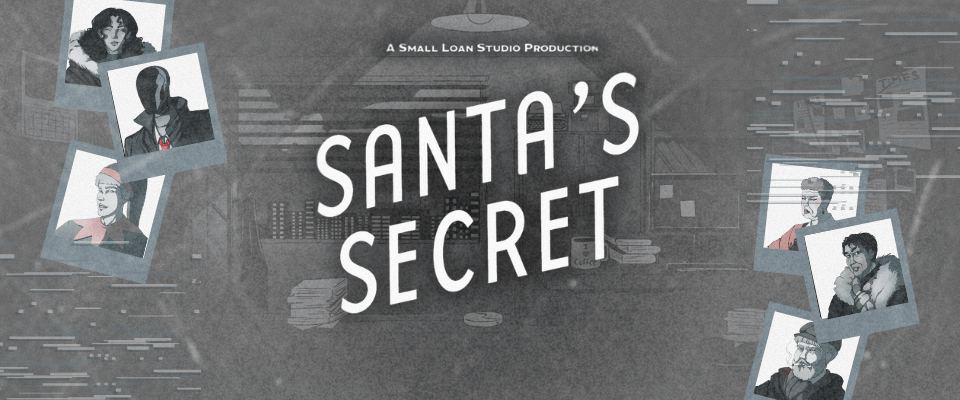
Premise:
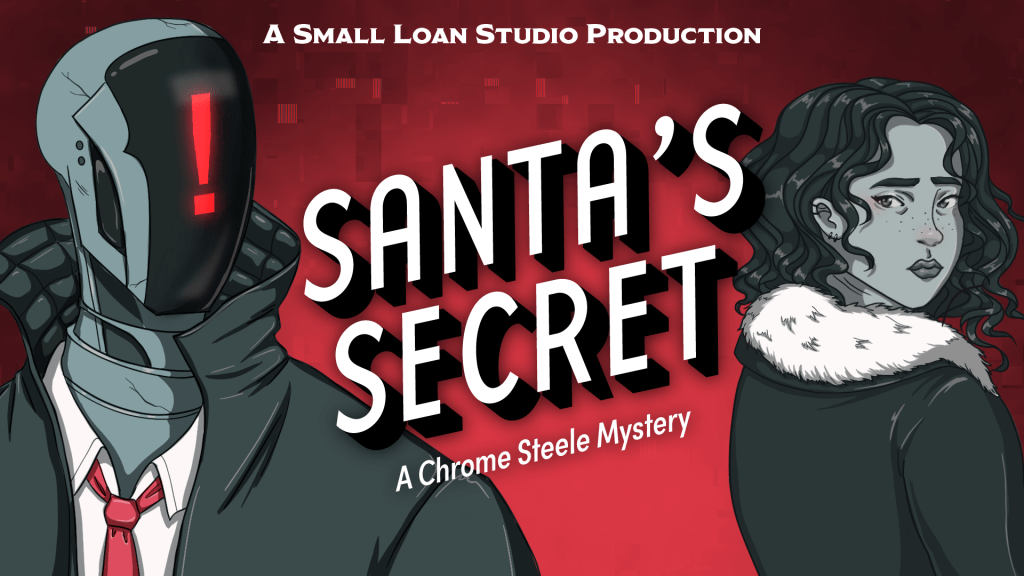
A desperate girl with a missing father turns to Chrome Steele P.I., an android detective heavily influenced by the fictional greats.
Chrome is led down an icy path of checkered pasts, shabby street Santas, and one decidedly dead elf in the pursuit of justice and redemption.
Can he find his own voice and the man at large before it’s all too late?
Role:
Narrative Lead: Submitted winning pitch voted on by the team. Wrote key scenes, advised on overall tone, and led the collaborative narrative pipeline.
Quality Assurance: Provided analysis for the QA team, including decision table and acceptable boundary coverage to test multiple endings, etc.
Original Pitch:
The pitch was centered around an android detective enamored by literary and tv detectives of the past. Familiar detective tropes such as:
- The logical, deductive, analytic, and impish nature of Sherlock Holmes and Auguste Dupin.
- The folksy, unassuming, and disarming styles of Columbo, Hercule Poirot, and Miss Marple.
- The noir, brooding, and hardboiled methods of Philip Marlowe and Sam Spade.
Players would switch between these styles via dialogue choices, trying to pick the best approach to crack the case. And writers would have fun crafting our android detective’s quest for finding his unique voice – oh, and solving the crime too! Thus Chrome Steele P.I. was born…
Original Pitch Document (Internal)
Details:
- Visual Novel written in Ren’Py
- Entered in the 2023 Winter VN Jam
- 20+ member team of writers, editors, producers, artists, sound designers, programmers, QA, etc.
- Core team comprised of The Narrative Department alumni of diverse backgrounds and experience levels
- 100% original art and music
Tools:

Below are some of the key tools used in making the game:
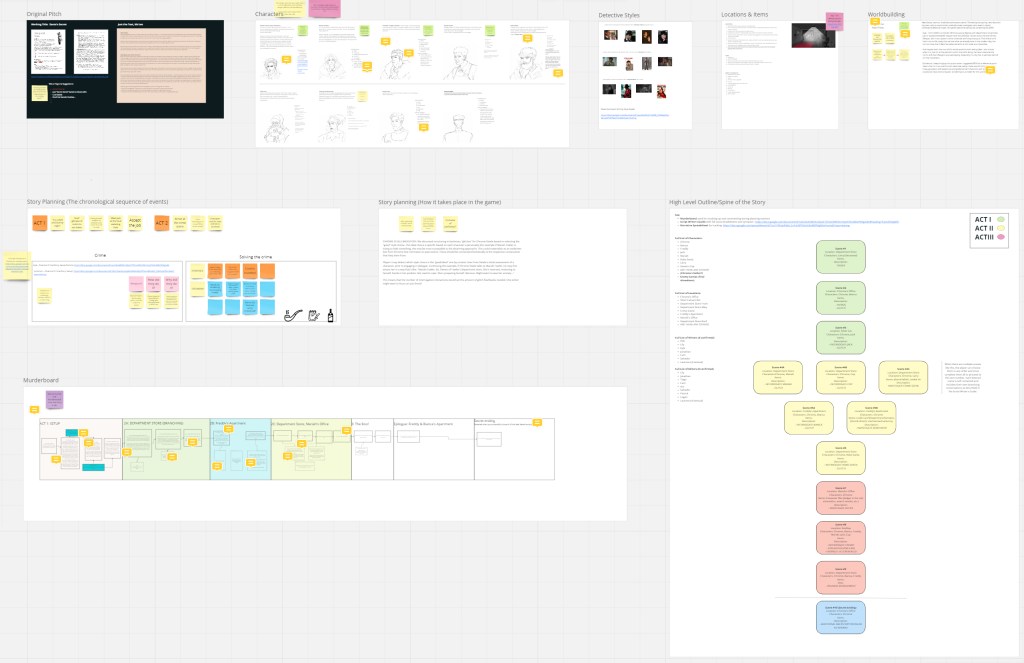
- Miro – collaborative brainstorming and design. Used extensively in writers’ room to develop the concept, share thoughts/comments, and map out story on the “murderboard.” Other boards included high-level scene flow, detective style guides, mug shots & sample dialogue of characters, etc. Anything about the core design of the game could be shared at a glance and across all teams.
- Notion – team workspace for information sharing, documentation management, note taking, task(kanban)/calendar management. This was our one-stop shop/DB. Our “intranet.”
- GitHub – code and game asset source repository, source control, collaborative branching/merging.
- Discord – team server for open communication with channels/roles per department, timely discourse, and a fair share of memes, pet pics, and food pics.
- Google Workspace – the script outline was worked on collaboratively in Google Docs, and then itemized into a Google Sheet for the assignment and tracking of 1st draft/edit and 2nd draft/edit. Individual scenes were worked on by associated writer in pseudocode template documents, linked in the spreadsheet, and ultimately shared with the programmers for implementation.
- Pinterest – graphical mood boards for art style and locations to inspire worldbuilding.
- When2meet – used to quickly gauge availability and best times for team meetings.
Links:
- Itch.io – https://smallloanstudio.itch.io/santas-secret
- Small Loan Studio – https://smallloanstudio.wordpress.com/
- YouTube – https://www.youtube.com/@SmallLoanStudio (enjoy the Jazz Theme from scene 3!)
- Twitter/X – https://twitter.com/SmallLoanStudio


 Robert Corra